Tennis Ball Launcher v1
Spring 2023 · High school capstone
Role
Quinn Morris
Solo: a full school year, start to finish
Description
My high school capstone project, where I went through the stages ofresearch, prototyping, and fabrication to build an automatic tennis ball machine. I was on thevarsity tennis and wanted more practice, but machines on the market started around $1,000. So I built one on a $300 budget.
Overview
Background
My capstone class tasked students to spend the year on one project of our choosing: research, plan, design, prototype, fabricate. I was playing tennis a lot at this time and wanted a way to practice own, and commercial ball machines were just way too expensive.
Build
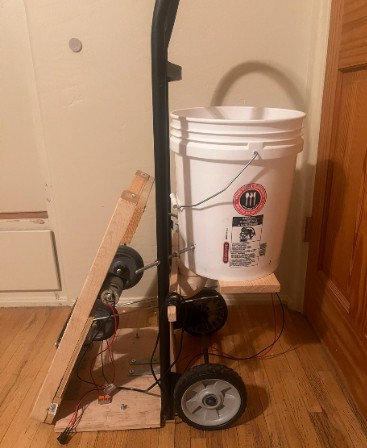
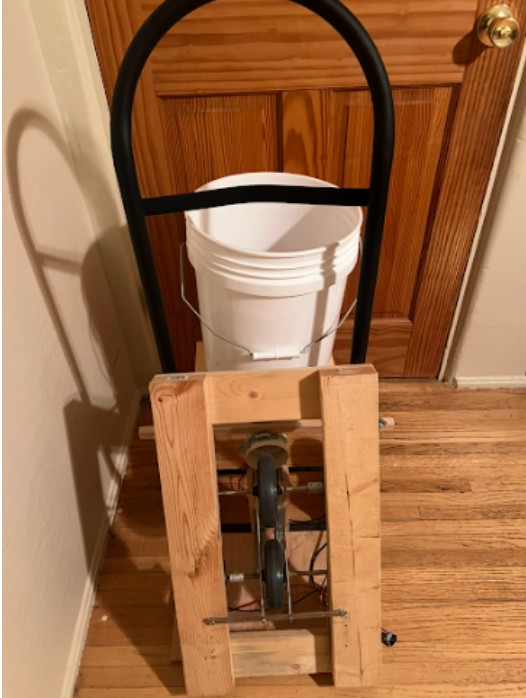
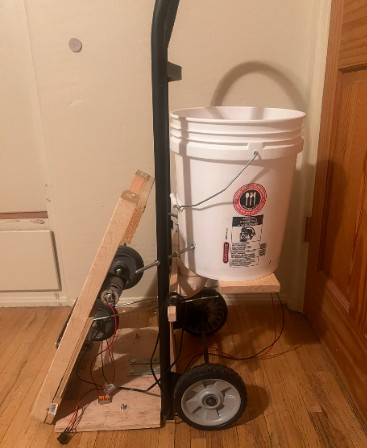
Three subsystems on a hand-truck chassis. A five-gallon bucket stores balls and drops them through a rotating laser-cut plate, two scooter wheels driven by independent reversible speed controllers launch them, and a hinged wooden frame sets the angle, all running off a 12 V sealed lead-acid battery through one switch.
Result
It fed and launched continuously with adjustable speed and selectable topspin, backspin, or flat, out to about 50 feet. It also failed in some major ways. Primarily, the epoxied wheel-to-shaft joints worked loose under load.
Ball feeding
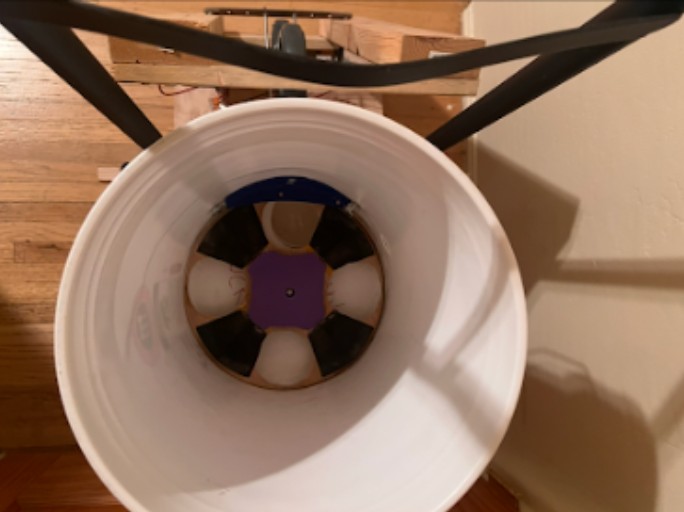
A five-gallon bucket with a hole cut in the bottom holds the balls. Inside, a laser-cut wooden plate with four ball-sized holes spins on roller bearings, driven by a high-torque 12 V motor through a shaft and coupling.
Every time a hole lines up with the bucket opening, one ball drops through. A speed controller sets the feed rate, and 3D-printed ramps on the plate plus a curved bracket over the opening keep balls from jamming.
Launching and spin
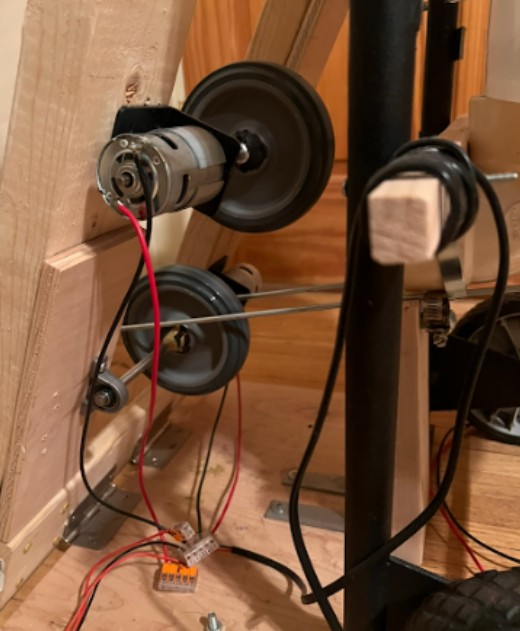
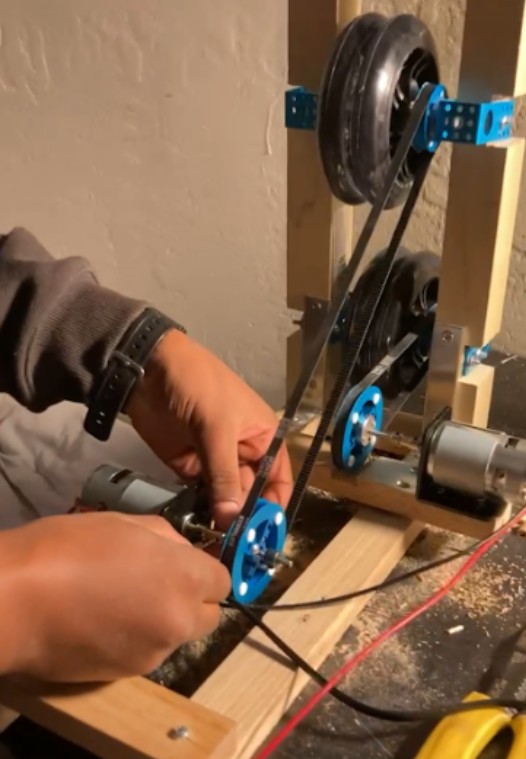
Two scooter wheels sit in a 2x4 frame with a 2" gap between them, sized so the ball compresses enough to be gripped but still pulls through. Each wheel runs on a 12 V motor through a shaft and coupling, supported on the far side by a pillow block bearing.
Both motors have their own reversible speed controller, so you can manually adjust launch speed, and control topspin and backspin.
Chassis and ball path
A hand truck is the main frame of this machine. The feeder bucket bolts to its handle, and a wooden base on the bottom carries the launch frame on hinges so the launch angle can be set.
Balls drop from the bucket into a curved PVC chute, then onto a track of thin aluminum rods spaced just under a ball's width, which carries them into the wheels. All three motors wire through a single switch to a 12 V, 7 Ah battery.
Prototype first
I mocked up configurations in scrap wood before committing to anything, which is where most of the design problems surfaced.
Everything else came out of the school makerspace: miter saw, band saw, jigsaw, drill press, belt sander, plus 3D-printed custom parts and laser-cut plate work.